Showing posts with label Online exhibitions. Show all posts

Sunday, February 1, 2009

Andrew Garn: Magnitogorsk


Andrew Garn
Man
[Magnitogorsk]
2000

A.M. Richard Fine Art

LL/27461

Most of us have everyday lives far removed from that of heavy industry and at times in my life I've worked for large conglomerates such as Firestone Tyres and in the cable and wire rope works of Bridon in the UK. There is a magnificence in heavy industry despite the grime and often terrible working conditions - the scale is awesome and the ingenuity that can create plants on some a scale stretches the mind. The recording of working conditions has a long tradition in documentary photography and it was common in the earliest Daguerreotypes to record workers with the tools of their trades - painters with their brushes, miners with shovels and picks and so on. Lewis Hine recorded aspects of child labor in the USA and the Bernd & Hilla Becher the typologies of industrial buildings. On this website there already exhibitions on the industrial remains of Eastern Europe recorded by Bruce Haley and the English industrial decay photographed by John Darwell.

In this online exhibition New York based photographer Andrew Garn takes us to Magnitogorsk in Russia.

The Magnitogorsk Metal Kombinat (MMK), built in the late 1920s during Stalin's Five Year Plan, is the largest steel plant in the world today. The sheer vastness and architectural complexity of this Siberian metal city, conceived with the ambition to become the "Pittsburgh of the East", is unparalleled throughout the world. An important record of political, social and manufacturing history, Magnitogorsk is also a feat of engineering and socialist ideals. The Russian steel plant, constructed on an uninhabited barren and hostile plain near the Ural River and a mountain rich in iron ore, stretches for over thirteen miles. By comparison, the great US Steel plant in Pittsburgh, PA, was a third of this size.

Thanks to Andrew Garn for his assistance with this exhibition.

There is an online exhibition on Luminous-Lint.

Saturday, October 25, 2008

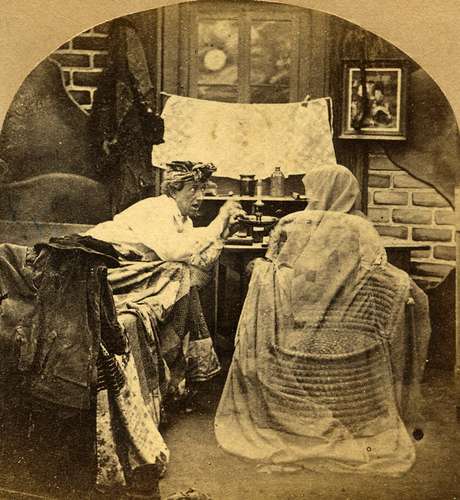
Ghosts, apparitions, angels, spiritual visitations and views of the future


Anon.
The Ghost
1860s

Stereocard, detail
Stereoviews: Stereoviews and Fine 19th & 20th Century Antique Photographs
Courtesy of David Spahr (www.stereoviews.com)

LL/30160

There can be few photography books as enjoyable as The Perfect Medium: Photography and the Occult by Clement Cheroux, Pierre Apraxine, Andreas Fischer, Denis Canguilhem and Sophie Schmit (Yale University Press, 2004). It takes us into the merging of the real and spiritual worlds with photographs of séances with automatic writing, table-tilting, and ectoplasm excreted by mediums as a physical manifestation of a haunting. It is a story of photography, science, legal proceedings and downright fraud.

This online exhibition of mostly nineteenth century material takes us into the ghostly world of grieving children in church yards, hair raising incidents, protective angels and unexpected apparitions on lonely roads.

Thanks to everybody for providing examples and particularly to Kevin Yee for nudging me along.

There is an online exhibition on Luminous-Lint.

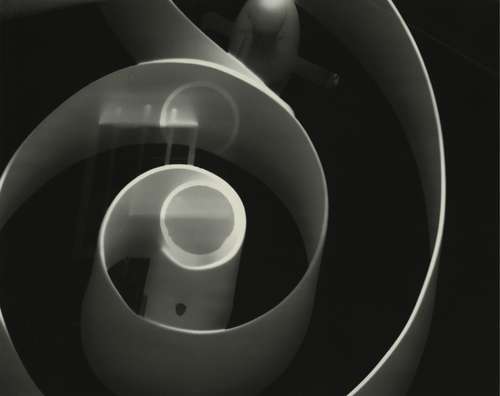
Museo d'Arte of Lugano: Photo20esimo - Masters of 20th Century Photography


László Moholy-Nagy
Untitled [Photogram]
1943

Gelatin silver print, photogram
199 x 254 mm

Private collection of Marco C. Antonetto
© L. Moholy-Nagy Foundation

LL/31104

At the Museo d'Arte of Lugano, Riva Caccia 5, CH - 6900 Lugano in Switzerland the exhibtion Maestri della fotografia del XX secolo [Masters of 20th Century Photography] is running from October 5, 2008 - January 11, 2009 and is based on a private collection of remarkable depth.

The exhibition is divided in a series of themes Abstraction, Portraiture, Art and Artists, Body, Landscape, Reportage, Still Life and Fashion and includes a selection of more than 300 works by masters such as Robert Capa, Robert Doisneau, Walker Evans, Robert Frank, Mario Giacomelli, Nan Goldin, Mimmo Jodice, André Kertész, László Moholy-Nagy, Helmut Newton, Robert Mapplethorpe, Irving Penn, Man Ray, Bettina Rheims, Alexander Rodchenko, Thomas Ruff, Andres Serrano, Cindy Sherman, Edward Steichen, Edward Weston and many others.

I'd like to thanks Marco Antonetto and the Museo d'Arte of Lugano for their assistance with this online exhibition.

There is an online exhibition on Luminous-Lint.
Tuesday, October 14, 2008

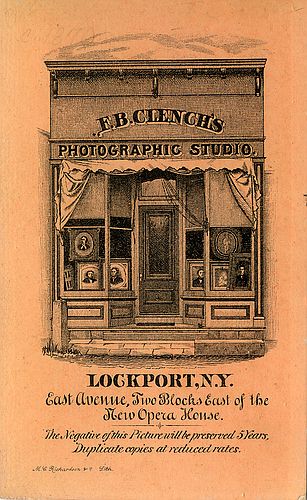
Carte-de-visite (CDVs)


F.B. Clench's
[USA]
n.d.

Carte de visite (Back)
Antiq-Photo / Rainbow Creations
Courtesy of Anthony Davis - Antiq-photo / Rainbow creations (www.19cPhoto.com)

LL/9388

For those that are intrigued by Carte-de-visite (CDVs) there is a Yahoo discussion group available at

http://tech.groups.yahoo.com/group/cartes_de_visite/

This groups is frequented by notable photo-historians and collectors of CDVs and if you have any questions it is a good place to follow up your research. I thought that it might be useful to show here some of the online exhibitions on Luminous-Lint that include CDVs.

1Carte de visite
2 Royalty
3 Celebrities
4 Occupational
5 Backs
6 Storage and display


With thanks to all of those that have shared their knowledge so willing over the last few years.

Tuesday, September 16, 2008

Peter Feldstein & Stephen G. Bloom: The Oxford Project


Peter Feldstein
Book cover for Peter Feldstein "The Oxford Project" (Welcome Books, 2008)
[The Oxford Project]
2008

Book cover
Welcome Books

LL/30404

"In 1984, Peter Feldstein set out to photograph every resident of his town, Oxford, Iowa (pop. 676). Twenty years later, he did it again. But this time those same residents did more than pose. With extraordinary honesty, they shared their memories, fantasies, failures, secrets and fears with writer Stephen G. Bloom. The result is a riveting collection of personal stories and portraits that tell much more than the tale of one small Midwestern town. Because beneath Oxford’s everyday surface, lives a complex and wondrous community that embodies the American spirit."

Thanks to Peter Feldstein, Stephen G. Bloom and Lena Tabori of Welcome Books for their assistance with this exhibition.

There is an online exhibition on Luminous-Lint.
Rick Dingus: An Evolving Retrospective


Rick Dingus
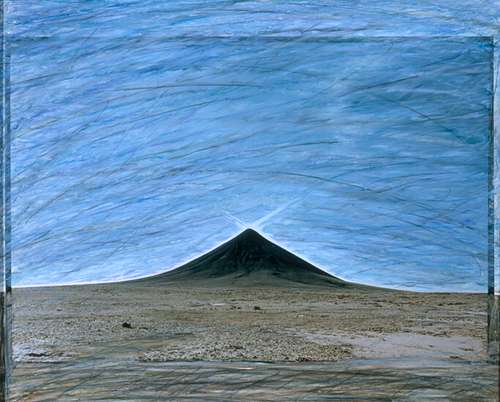
Mound That Recedes When Approached
[Navajo Places]
1992

16 x 20 in

Provided by the artist - Rick Dingus

LL/30739

Rick Dingus in this online exhibition on Luminous-Lint explores the nature of place as he describes in his introduction.

"I photograph places that interest me because they contain details that pose questions related to a broadly defined notion of "Landscape." I'm interested in any situation that prompts contemplation of the curiously complex connections we share with the larger patterns of existence. Remote wilderness and rural settings, vernacular byways, urban environments, ancient pathways, ruins, historic, mythic and spiritual pilgrimage sites, scientific and technological research facilities, folk and professional museums, shrines, collections, displays, and dioramas all fascinate me because these places reflect individual and collective responses, understandings, and a myriad of relationships to the same world I live in. I've shifted frames of reference continually, seeking new insights that might be hidden behind the details that are in plain view."

Thanks to Rick Dingus for his enthusiasm and assistance with this exhibition.

There is an online exhibition on Luminous-Lint.
Saturday, September 13, 2008

The Roz Leibowitz Collection: Snapshot Disasters


Anon.
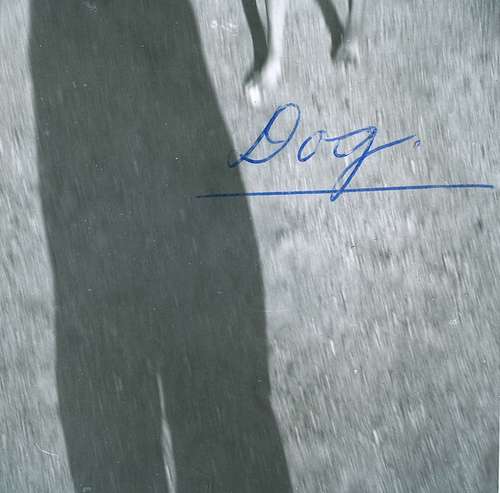
dog
[Snapshot Disasters]
1955

Gelatin silver print, snapshot
3 x 5 in

Private collection of Roz Leibowitz

LL/30869

Soon after I put up the recent exhibition on Abstract: Multiple exposures - Snapshots on August 22, 2008 I received an enthusiastic email from Roz Leibowitz of New York with the generous offer of some additional images. In a flurry of emails I learnt that Roz is passionate about the snapshot and so we decided to do an online exhibition on Snapshot Disasters and her CD arrived through yesterday. We are entering a weird world here as Roz explains in her introduction:

"First it was the light flashes, which I still believe are a sign of other worlds making their presence known on this plane. Then it was the hidden writing on the back or even the front of the photos. Such a perfect matching of text and image still takes my breath away. Then I noticed the multiple exposures. ‘She clicked it twice!‘ a woman named Nell screams from the back of a snapshot I call ‘whole lotta shaken going on‘. That’s the rational explanation. And professionals can tell me where all these lights and orbs and lines and streaks come from. I do not care. Nell knew what I know, that the snapshot disaster is often the one we remember and save for others to share."

It takes a collector with a different view of the world to preserve these visual oddities and thanks to Roz for sharing items from her collection. With the help of collectors around the world we are able to share themes in the ever-evolving history of photography that have rarely been seen. I know I keep saying it but thanks to you all for your support.

There is an online exhibition on Luminous-Lint.

Thursday, September 11, 2008

The Hill Collection: Architectural Photography in the 19th Century


Giacomo Brogi
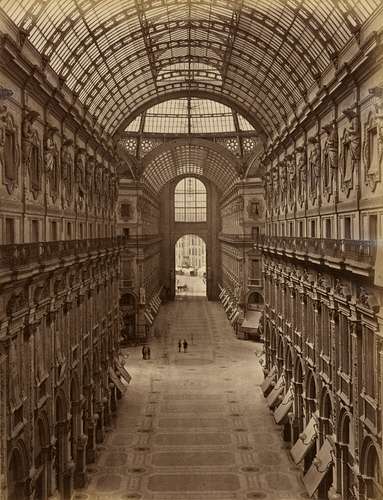
Milano, Galleria Vittorio Emanuele
1870 (ca)

Albumen print from glass plate negative
25 x 19 cm (image)

Private Collection of Robert G. Hill, Toronto, Ont.
www.hillcollection.com - Acc: 584

To develop a significant collection requires knowledge, a desire to learn and passion. By concentrating on a single theme, period or technique the collection is honed and this is what Toronto-based architect, architectural historian and architectural photographer Robert G. Hill has achieved. His collection of over 1,000 prints from the mid-19th century is over 90% albumen prints and focuses exclusively on architecture.

The collection includes works by the masters of 19th century architectural photography including the Alinari Brothers, Gioacchino Altobelli, James Anderson, Edouard Baldus,Antoine Beato, Henri Bechard, Francis Bedford, Auguste R. Bisson, Felix Bonfils, Samuel Bourne, Adolphe Braun, Domenico Bresolin, Giacomo Brogi, Charles Clifford, Pietro Dovizielli, Roger Fenton, Francis Frith, Juan Laurent, Robert Macpherson, Charles Marville, Carlo Naya, Etienne Neurdien (ND), Antonio Perini, Carlo Ponti, Pompeo Pozzi, Achille Quinet, James Robertson, Pascal Sebah, Giorgio Sommer, Charles Soulier, James Valentine and George W. Wilson.

I'd like to thank Robert G. Hill for his patience and enthusiasm in sharing these prints from his remarkable collection. As Robert wrote in an email "I hope this generates some interest in the subject of architectural photography." - I'm sure it will given these examples.

There is an online exhibition on Luminous-Lint.
Tuesday, September 9, 2008

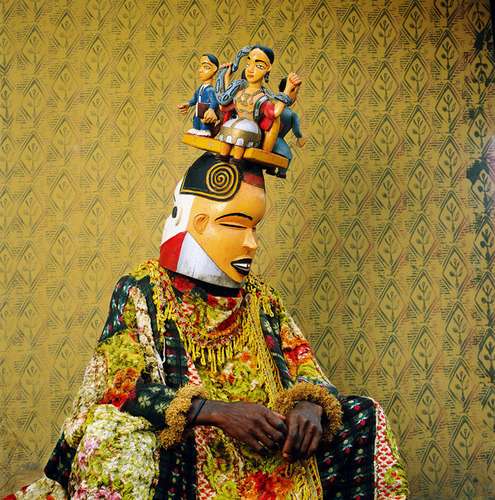
Phyllis Galembo: West African Masquerade


Phyllis Galembo
Mami Wata Mask, Cross River, Nigeria
[West African Masquerade]
2004

Ilfochrome
30 x 30 in

Steven Kasher Gallery
Courtesy of the Steven Kasher Gallery and the artist Phyllis Galembo

LL/30362

At the Fowler Museum at UCLA in Los Angeles there was a remarkable exhibition on Mami Wata: Arts for Water Spirits in Africa and Its Diasporas (April 6 - August 10, 2008) that showed the material complexity of a highly significant spiritual personality within the traditions and beliefs of Africa and the African Atlantic. Mama Wata, the water spirit with numerous guises, is one of the cast of characters who appears in this exhibition by New York-based photographer Phyllis Galembo.

Since 1997 Phyllis has attended festivals or sought out the masked performers who participate in the rituals of Benin, Nigeria and Burkina Faso. She has also followed the paths of the African diasporas to the Caribbean and recorded carnival in Haiti. Her portraits of costumed performers show us the material culture of the spirit world - the fashions of belief.

Thanks to Phyllis Galembo for her assistance with this exhibition.

There is an online exhibition on Luminous-Lint.
Monday, September 8, 2008

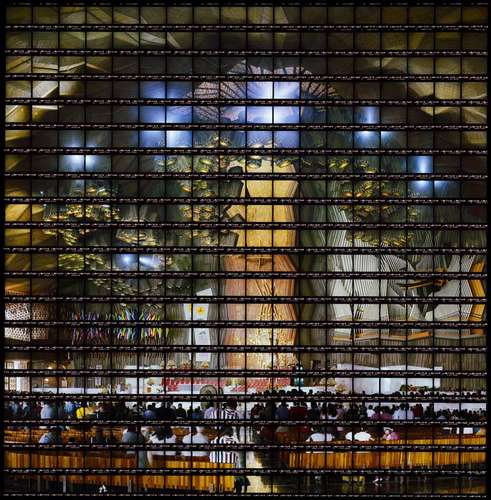
Thomas Kellner: Dancing Walls


Thomas Kellner
66#11 Mexico, Basilica de Guadelupe
[Dancing Walls]
2006

C-print
68.2 x 69.7 cm / 26.6 x 27.2 in

Provided by the artist - Thomas Kellner

LL/30052

From the introduction to this new exhibition on Luminous-Lint of the works of Thomas Kellner:

Each photographic work since 1997 is methodically made up of horizontally placed film strips of up to one thousand two hundred and sixty nine individual pictures. Every single one of these smaller images were taken with the camera from a slighlty shifted perspective and subsequently combined into an overall picture, creating an entirely new image. As an artistic photomontage – originally fused as a group of film strips, then as an exposed contact print, presently prepared digitally – each large-scale color photograph reveals its creation process upon closer inspection. With this his approach Thomas Kellner stands together with traditional procedures in photography history that examine not only the camera as an apparatus for producing images, but also the process in which we perceive images.

“Kellner is closer to David Hockney and his idea of grasping something with multiple pictures, since a single photograph simply isn’t enough. (…) Thus, Thomas Kellner does not photograph architecture, but perceptions of architecture. He reconstructs our picture memory. He doesn’t document, he archives.”

Reinhold Misselbeck, former Curator of Photography, Museum Ludwig, Cologne, in: Eikon Vol. 38, Vienna, Austria, 2002

Thanks to Thomas Kellner for his help with this exhibition.

There is an online exhibition on Luminous-Lint.
Friday, September 5, 2008

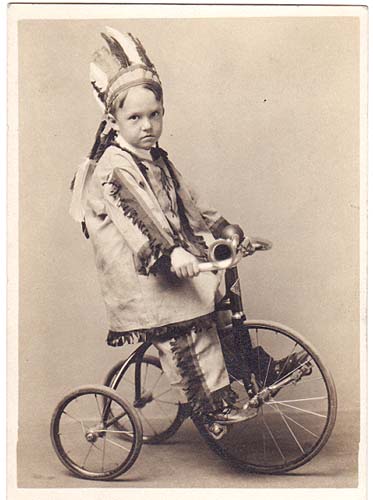
Real Photo Postcards - Portraits: The Brian Smolens Collection


Anon.
[Boy on tricycle]
1905-1915 (ca)

Real photo postcard
Private collection of Brian Smolens

LL/30531

During this week I've been contacted by three private collectors with extraordinary material and over the coming weeks exhibitions will be appearing on Luminous-Lint. One of these collections has been amassed over the last 35 years by Brian Smolens and consists of over 8,500 American real photo postcard portraits. The real photo postcard in the USA was a specific photographic format that was popular from about 1905 until 1920. Although the more widely known picture postcards were printed mass-market items, the real photo postcards comprising the archive are individually developed photographs. Many were unique prints originally and most of the remainder are the only surviving copies.

Although there are a few highly sophisticated collectors of real photo postcards, such as cosmetics executive Leonard Lauder, most photography dealers and collectors remain unaware of the significance of this photographic format. One of the truly great real photo postcard collections to be created was assembled by Andreas Brown, noted New York bookseller and author of Prairie Fires and Paper Moons: The American Photographic Postcard, 1900-1920. Much of the Andreas Brown collection was subsequently sold to The J. Paul Getty Museum, but is not believed to be publicly exhibited.

Thanks to Brian for sharing some of his remarkable collection and in discussions I gather that he is interested in selling the entire archive. Given the scale and quality of the collection this is a rare opportunity for an institutional purchase.

There is an online exhibition on Luminous-Lint.

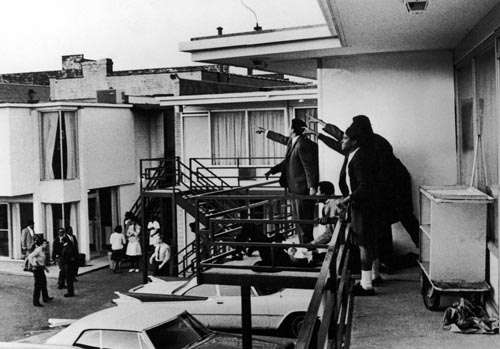
It Was Forty Years Ago Today...


Joseph Louw
Dr. Martin Luther King assassination, Memphis, Tenn.
[LIFE Magazine Photographers]
1968, 4 April

Gelatin silver print
16 x 20 in

Monroe Gallery Of Photography
© Time Inc.

This new exhibition on Luminous-Lint examines the 1960s through the famous images of the period. Eddie Adams and the Street execution of a Viet Cong prisoner, Saigon (1968), the Bill Eppridge images of Senator Robert F. Kennedy on the night he was shot, Joseph Louw on the Dr. Martin Luther King assassination, Memphis, Tenn. and the overtly political 1968 Olympics Black Power salute taken by John Dominis - these are the images that serve as the mental "post-its" for significant historical moments of the 1960s.

Thanks to Sid Monroe and the Monroe Gallery (Santa Fe) for his assistance with this exhibition of iconic images.

There is an online exhibition on Luminous-Lint.

Tuesday, September 2, 2008

Chen Jiagang: The Great Third Front


Chen Jiagang
The Great Third Front #11
[The Great Third Front]
2008

C-print
Edwynn Houk Gallery
© Chen Jiagang, Courtesy Edwynn Houk Gallery, New York

LL/30440

Chinese contemporary photography is a vibrant mix of the old and new with commercial astuteness blended into a questioning of socio-cultural values. Chen Jiagang's photographs examine the industrial legacy of the "Third Front" of the 1960s when heavy industry was moved from border regions towards the more secure interior.

A self-described expressionist photographer, Jiagang’s photographs conjure a type of industrial fairy tale. With the digital addition of an element of the fantastic, a young girl elegantly dressed in the Maoist collar and dress (Qipao), Jiagang’s photographs allude to a former glory, a nostalgia for a period now lost to the more powerful forces propelling China into the future.

Thanks to the Edwynn Houk Gallery (New York) for their assistance with this exhibition.

There is an online exhibition on Luminous-Lint.

Monday, September 1, 2008

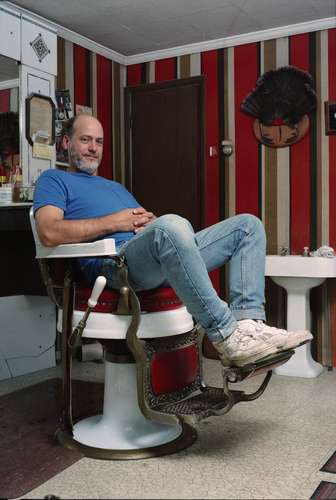
Doug Dubois - Barbershop


Doug Dubois
Untitled
[Barbershop, Avella, PA]
1994-1997

C-print
20 x 24 in

Provided by the artist - Doug Dubois

LL/30322

Thanks to Doug Dubois for granting permission to include his Barbershop series on Luminous-Lint.

"In the mid 1990’s, I spent much of my summer photographing in Avella, a vanishing Pennsylvania coal town located at the edge of the West Virginia panhandle. There are no restaurants in Avella, only a few mean looking bars that I wasn’t ready to enter. To get out of the heat, my only choice was the barbershop.

The pictures I made of the customers took three summers to get right. The first set suffered from an uneven light that left their feet dark and out of focus. The second summer had better lighting but the back door was sometimes open, sometimes closed.

By the third summer, the barber, Dominic, took control. After each haircut he would announce my intentions: This fellow wants to take your picture. He teaches college out in New Mexico. He's doing a project on Avella. His Grandparents came from here.

Without waiting for a response he would turn the chair to a profile, shut the back door and tell me to hurry up and take the damn picture.

What I garnished from those three summers was more than the skills required to photograph in a barbershop. During the haircuts, I listened carefully to the stories and conversations. Some of the talk centered on their ageing bodies – hemorrhoids being an almost universal complaint. But in essence, the barbershop was the place for male gossip: a lively mix of politics and nostalgia with a more than a few dirty jokes on the side. It was my entrée into the life of the town and my first successful attempt at making portraits in a series."


Doug Dubois
Sept 1, 2008

There is an online exhibition on Luminous-Lint.

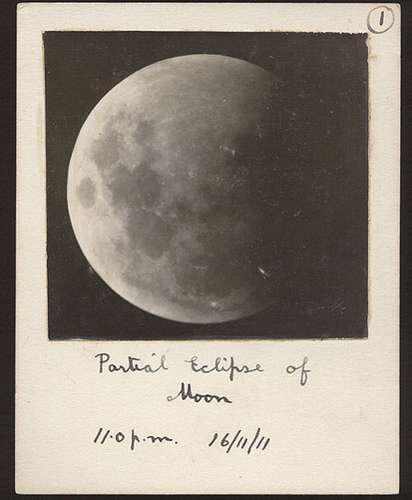
Scientific: Astronomical Snapshots - 1911-1915


Anon.
Partial Eclipse of Moon
1911, 16 November, 11:00 pm

Gelatin silver print
Christopher Wahren Fine Photographs

LL/30248

This exhibition on Luminous-Lint highlights the work of an anonymous British amateur who was taking astronomical photographs between 1911 and 1915. It includes a series of photographs of Comet Brooks taken between August 14 and October 11, 1911, partial lunar and solar eclipses and a variety of nebulae, galaxies, stars and solar spectra.

We may never know who took these photographs but there is a strange fascination with the slow build up of expectation over the sixteen photographs that make up the Comet Brooks series from the first sighting to its rise to brillance and eventual passing. His observations may have been curtailed by the First World War (1914-1918) but this is not certain.

Thanks to Christopher Wahren for his assistance with this exhibition.

There is an online exhibition on Luminous-Lint.
Friday, August 22, 2008

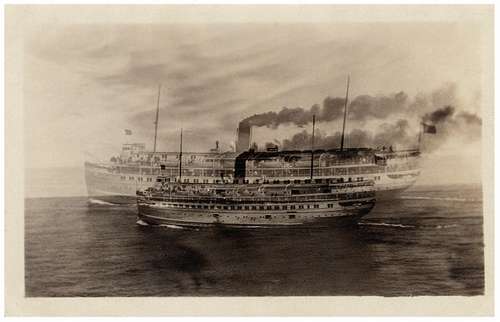
Abstract: Multiple exposures - Snapshots


Anon.
Untitled [Two steamships]
1940 (ca)

Gelatin silver print, snapshot, double exposure
3.5 x 5.5 in

Private collection of John Foster
Copyright www.accidentalmysteries.com - Collection of John and Teenuh Foster

An increasing critical interest in vernacular photography and the snapshot has led to exhibitions and books in the last decade and a new online exhibition has been added to Luminous-Lint. The exhibition The Art of the American Snapshot 1888-1978 at the National Gallery of Art came from the collection of Robert E. Jackson and the Accidental Mysteries touring exhibition came from the collection of John and Teenuh Foster (www.accidentalmysteries.com). Other exhibitions such as Close to Home: An American Album at the Getty Center (October 12, 2004 - January 16, 2005) highlight how the photographic snapshot is being accepted as an integral part of socio-cultural history.

This exhibition includes examples of multiple exposures kindly provided from a number of private collections. Some of these are intentional whilst others are accidents of camera malfunction or failing to wind on the film. Some show elements of two frames whilst others are superimposed. In most examples the camera has been kept on the same axis for both images but in some cases landscape and portrait formats are merged to create confusingly powerful visual memories of soldiers blended with indigenous peoples. At times it can be uncertain if the result was planned in advance or a strange alignment of stars.

This is part of a number of exhibitions on Multiple Exposures that will be shown on Luminous-Lint and as always we welcome additional examples. Thanks to John Foster, Norman Kulkin, Nigel Maister and the private collectors who have provided examples for this exhibition.

Further reading:

Ford, Colin, and Karl Steinorth, eds. You Press the Button, We Do the Rest: The Birth of Snapshot Photography London: D. Nishen, 1988.

Greenough, Sarah & Waggoner, Diane, 2007, The Art of the American Spanshot 1888-1978', (Washington: National Gallery of Art in association with Princeton University Press) [ISBN: 978-0-691-13368-3]

Johnson, Robert Flynn (Editor); & Boyd, William (Introduction), 2004, ‘Anonymous. Enigmatic images from unknown photographers.’, (New York: Thames & Hudson) [Hardback] [ISBN: 0500542929]

Skrein, Christian R. (editor, Essay); Aletti, Vince (Essay); & Aigner, Carl (Essay), 2004, ‘Snapshots: The Eye of the Century’, (Hatje Cantz Publishers) [Hardcover] [ISBN: 3775713964]

There is an online exhibition on Luminous-Lint.
Sunday, August 17, 2008

Larry Wiese: An Evolving Retrospective


Larry Wiese
Front Porch - Marshfield, CA
[Color landscape]
2005, 23 November

Digital pigment print
5 x 6.25 in

Wall Space
This print was included in the exhibition Larry Wiese: Recall at the wallspace Gallery, Seattle (August 5 - August 30, 2008).

"It is said that the true artist is one who sees what others do not and then make it visible. Larry Wiese understands what it means to be an artist. He lives it, and it is evident in his photographs. So much of photography these days is repetitious and unoriginal, even codified--what is acceptable subject material, how it is supposed to look. And then you come across the photography of Larry Wiese - powerfully seen yet quiet. His images whisper rather than shout. And in each photograph one has the haunting feeling that you are on the edge of hearing a great cosmic secret, of seeing a mystery unfold. He sees what others do not, but it is even more than that. What sets Larry's work apart and makes him a true artist is not what he sees but how he sees. He gives us new eyes. And this is the highest form of artistry."

Brooks Jensen, Editor
LensWork Publishing

Thanks to Larry Wiese for his help with this online exhibition.

There is an online exhibition on Luminous-Lint.
Robert Gardner: The Borroro - Gerewol and Yaki


Robert Gardner
Untitled
[Yaki dancer's faces]
1978

Kodachrome slide film
Provided by the artist - Robert Gardner
Taken during filmmaking and anthropological research in the Sahel region, Niger.

New online exhibition on Luminous-Lint.
"It was a surreal assembly of painted and costumed dancers swaying in front of a fire that sent clouds of embers and sparks across the desert floor. The sound of dancer’s leg rattles and chorused voices were alternately swallowed and amplified by the gathering winds. It was a contest between men and the elements, something I have witnessed often since coming to the Sahel." (Robert Gardner The Impulse to Preserve, Peabody Press. 2006)

Bob Gardner is a distinguished filmmaker, anthropologist and photographer and was Director of the Film Study Center at Harvard University from its foundation in 1957 for over 40 years. His films including Dead Birds, Rivers of Sand and Forest of Bliss are classics within their genre. Thanks to Bob for kindly providing this exhibition.

There is an online exhibition on Luminous-Lint.

Saturday, August 16, 2008

Knight of the Camera: The Photographs of Sir Benjamin Stone M.P.


John Collier
J.B. Stone, President of the Birmingham Photographic Society
1895 (ca)

Birmingham Central Library
Copyright: Birmingham Library and Archive Services

A new online exhibition has been added to Luminous-Lint. From 20th September - 31st October 2008 an exhibition of the photographs of Sir Benjamin Stone M.P. will be held in Centenary Square, Birmingham, UK. Though not a household name now he certainly was in the later 19th and early 20th centuries in Great Britain where he was "playfully dubbed ‘Sir Kodak’, ‘Sir Snapshot’ and ‘The Knight of the Camera’." - a point made by Peter James who curated this exhibition.


‘…Benjamin Stone is a national institution. Photography has been with him, as has been well said, not a hobby but a passion…’

The Strand Magazine, 1910.


A passionate amateur photographer he recorded his travels, notable visitors to the House of Commons and established the National Record Association to photograph the buildings, everyday life, manners and customs of Great Britain. The tradition of recording folk customs and traditions has been continued in the UK by Doc Rowe and Homer Sykes.

With thanks to Peter James, Curator of Photography, Birmingham Central Library, UK for kindly curating this exhibition.

There is an online exhibition on Luminous-Lint.
Sunday, August 10, 2008

National Gallery of Australia: Picture Paradise - Asia–Pacific photography 1840s–1940s


Douglas T. Kilburn
South-east Australian Aboriginal man and two younger companions
1847

Daguerreotype, quarter plate
8.2 x 10.8 cm

National Gallery of Australia

The National Gallery of Australia in Canberra has been expanding its collection of photography of South East Asia and the Pacific and is currently showing (July 11 - November 9, 2008) an exhibition of over 400 photographs from its own holdings and those of public and private collections. Some of these photographers, and the images they created, will be known to photo-historians but to many of us there are novelties to marvel at. An 1847 quarter plate Daguerreotype by Douglas T. Kilburn of "South-east Australian Aboriginal man and two younger companions" or the whole plate by Hugo Stangenwald "The Hawaiian royal family, Kamehameha " taken in about 1853 and in the collection of the Bishop Museum, Honolulu. An online exhibition has been added to Luminous-Lint on this exhibition.

An introduction has been kindly provided by Gael Newton, Senior Curator of Photography at the National Gallery of Australia and curator of the real world exhibition. The introduction reveals the diverse relationships between the royal courts of the region and the first photographers. The overall exhibition is a highly significant and well researched examination of a region that is frequently given cursory paragraphs in the more general histories of photography. The catalog of this exhibition will be a considerable contribution to photo-history and I will certainly be buying a copy.

For additional essays and background material visit the Picture Paradise website.

I'd like to thank Gael Newton at the National Gallery of Australia for her enthusiastic assistance and David Knaus for permission to include photographs from his collection.

There is an online exhibition of this important exhibition on Luminous-Lint.